
For the sake of safty, mostly, the marble stone tiles are reinforced with embedded fiberglass rods on the back to prevent cracking.
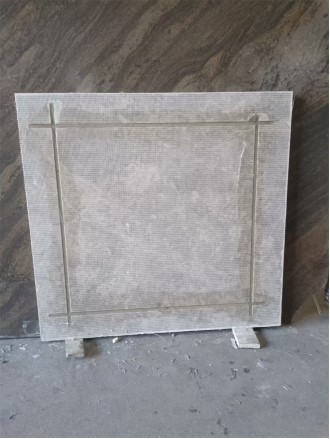
Why?
Of course, this is a very important and professional process. The main reason for embedding reinforcement strips (usually fiberglass rods) on the back of marble can be attributed to one point: to compensate for the natural mechanical defects of marble, improve its strength, and ensure safe and long-lasting use.
Specifically, there are several core reasons:
1. Prevent cracking and fracture
The essence of marble: Marble is a natural stone material that, although hard, also has the characteristics of high brittleness and low bending strength. This means that it is prone to bending and breaking when subjected to forces perpendicular to the surface of the board.
The "spine" effect: Reinforcing strips are like attaching a "spine" to marble slabs. When the board bends due to its own weight or external loads (such as trampling or impact), the reinforcement strip can effectively resist this bending deformation, disperse the stress, and greatly reduce the risk of cracking and fracture.
2. Enhance bending strength
This is the most direct and primary purpose. A marble slab without reinforcement bars is like an ordinary biscuit, breaking easily when broken. After embedding the reinforcement strip, it becomes a composite structure similar to "reinforced concrete":
Marble is responsible for bearing pressure.
The reinforcement strip is responsible for bearing tensile stress.
Through this combination, the overall bending strength of the board is significantly improved, enabling it to span larger spans and withstand greater loads.
3. Easy to transport and install
Large sized slabs: Modern decoration commonly uses large-sized rock slabs or thin sheets, which are very easy to break due to shaking during transportation and installation. Reinforcing strips can ensure that they remain intact during transportation and installation.
Reduce damage rate: Reinforcement measures can significantly reduce the damage rate throughout the entire process from the factory to the construction site, saving costs.
4. Prevent deformation in the later stage
Even installed floors or countertops may undergo minor deformations under long-term uneven stress or temperature changes. Reinforcing strips can provide continuous support, help maintain the flatness of the board, and prevent future sinking or warping.

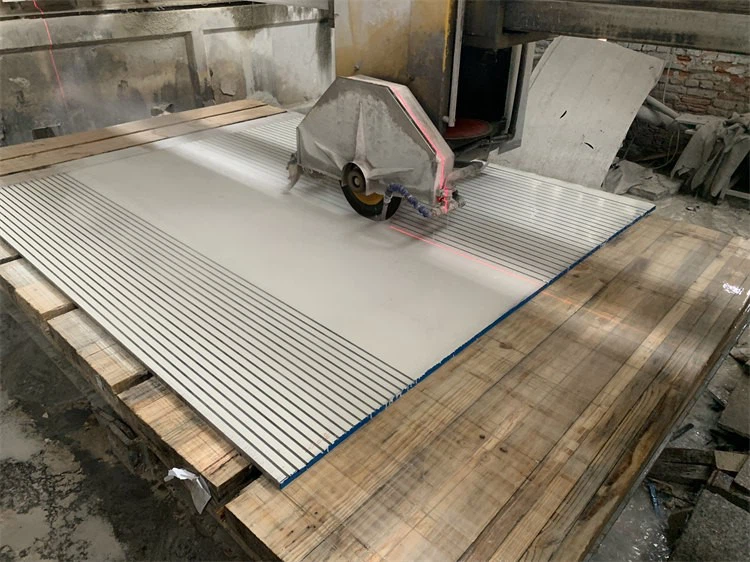


What situations require reinforcement in particular?
- Large size boards: The larger the size, the easier it is to break, and reinforcement is more necessary.
- Thin plate: For example, a plate with a thickness of 1.5cm or less.
- Used as countertop: Cabinet countertops, bathroom countertops, etc. have suspended parts that are subjected to concentrated forces and must be reinforced.
- Stones with natural cracks or fragile textures: Some marble stones have hidden cracks or soft texture, and reinforcement is a necessary process.
Why are glass fiber rods commonly used instead of real metal bars?
The term 'plastic steel' mentioned in your question mostly refers to fiberglass in the industry, because:
- No rust risk:Metal (such as steel) will rust, and after rusting, its volume will expand, causing the stone to crack from the inside. Fiberglass never rusts.
- Matching of thermal expansion coefficient: The thermal expansion and contraction coefficient of glass fiber is closer to that of stone, avoiding cracking of stone due to uneven expansion and contraction during temperature changes.
- Good adhesion: The bonding effect between glass fiber and epoxy resin adhesive is very good, which can form a solid whole.
In summary, embedding reinforcement strips on the back of marble is a crucial 'safety measure'. It greatly improves the engineering performance of stone through simple processes and is an essential technology for achieving safe, reliable, and long-term use of marble decoration.