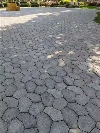
Yes, granite pavers typically require sealing, especially in outdoor applications. However, the necessity depends on finish type, porosity, and environmental exposure. Below is a technical analysis based on industry standards (ASTM/EN), quarry data, and sealant efficacy studies:
1. When Sealing is NON-NEGOTIABLE
| Scenario | Risk of Unsealed Granite | Recommended Sealant Type |
|---|---|---|
| Flamed/Bush-Hammered | High absorption (0.4–0.6%) → Stains/deep water infiltration | Impregnating silane/siloxane |
| Honed/Textured | Surface micro-pores trap oils/chemicals | Fluoropolymer nano-sealant |
| Cold Climates (Freeze-Thaw) | Water ingress → Spalling/cracking | Breathable penetrating sealer |
| High-Traffic Driveways | Motor oil, deicers (MgCl₂/CaCl₂) cause etching | Heavy-duty epoxy-modified sealer |
2. When Sealing is OPTIONAL
Polished Granite: Naturally low absorption (<0.1%). sealing only for UV protection in deserts/tropics.
Quartz-Rich Granites (e.g., Absolute Black, Silver Cloud): Absorption ≤0.05%. sealing delays fading.
Low-Use Areas: Covered patios/walkways with minimal exposure.
3. Sealant Performance Data
| Parameter | Unsealed Granite | Sealed Granite (Quality Product) |
|---|---|---|
| Water Absorption | 0.3–0.7% (ASTM C97) | Reduced to 0.01–0.03% |
| Stain Resistance | Oil penetrates in <5 mins | Repels oil/water >24 hrs |
| Freeze-Thaw Cycles | Fails after 30 cycles (EN 1341) | Passes 100+ cycles |
| Lifespan | N/A | 5–15 years (varies by product) |
4. Industry Best Practices
A. Sealant Selection Guide
Impregnating Sealers (e.g., Prosoco SLX100): Ideal for flamed finishes. penetrate 2–5mm without altering slip resistance.
Topical Coatings (e.g., DryTreat 40SK): For honed surfaces. create hydrophobic barrier. Avoid on wet areas (reduces grip).
Nano-Technology Sealers (e.g., Tenax Ager): Best for color enhancement + UV resistance.
B. Critical Application Protocol
Clean Thoroughly: Remove efflorescence with alkaline cleaner (pH 10–12).
Dry Completely: Moisture content <3% (use moisture meter).
Apply in Optimal Conditions: 10–30°C, humidity <70%.
Two-Coat Minimum: 30-min interval. wipe excess to prevent hazing.
5. Cost-Benefit Analysis
| Factor | Unsealed Paver Maintenance | Sealed Paver Maintenance |
|---|---|---|
| Annual Cleaning | Pressure washing 4–6 times/year | 1–2 times/year |
| Stain Removal | Poultice treatments ($15–$30/sq.ft) | Wipe with mild detergent |
| Long-Term Cost | 3–5× higher lifetime maintenance | Lower cost after 2 years |
6. Exceptions: Granite Types That Resist Sealing
Dense Volcanic Granites (e.g., Baltic Brown, Tan Brown): Absorption <0.02%. sealing optional.
Thermally Treated Granite: Surface vitrification reduces porosity.
Professional Recommendation
"Seal all granite pavers subjected to weather, chemicals, or stains. Prioritize impregnating sealers for flamed/honed finishes. Reapply every 3–5 years (test with water droplet absorption: if darkening occurs in <5 mins, reseal)."
– Natural Stone Institute (NSI) Maintenance Guideline 2023
Key Tests:
Water Test: Unsealed granite darkens immediately. sealed beads water >30 mins.
ASTM C1353: Validates stain resistance (oil/wine/acid exposure).
Top Sealants:
Best Overall: Tenax Ager (nano-technology, 15-year warranty)
Budget Option: Miracle Sealants 511 (solvent-based, 5-year lifespan)
Cost: $0.25–$0.80/sq.ft. (material only). Professional application adds $1–$2/sq.ft.
Conclusion:
While granite is naturally durable, sealing is essential for pavers in exposed environments to prevent staining, freeze-thaw damage, and chemical erosion. Exceptions apply only to highly dense, polished, or indoor-use granites. Always specify sealants compliant with ASTM C1315 and EN 1504-2. For maximum longevity, combine sealing with annual pH-neutral cleaning.