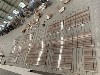

The production of polished marble tiles involves multiple stages, from raw block selection to final finishing. Here's a detailed breakdown of the process:
1. Raw Block Selection (Quarrying & Inspection)
Quarrying: Large marble blocks (called rough blocks or raw blocks) are extracted from quarries using diamond wire saws.
Quality Check: Experts inspect the blocks for color consistency, veining patterns, and structural integrity. High-quality blocks are chosen for further processing.

2. Cutting Blocks into Slabs (Multi-Blade Gang Saw or Block Cutter)
The selected marble blocks are cut into large slabs (typically 1.8cm, 2cm or 3cm thick) using:
- Gang saws (multiple diamond blades cutting simultaneously)
- Wire saws (for more precise cuts)
- Block cutters (for smaller-scale production)
The slabs are then labeled and sorted based on quality and appearance.

3. Drying & Resin Reinforcement (Strengthening the Slabs)
Drying: Freshly cut slabs are left to dry in open yards or drying chambers to remove moisture.
Resin Application (Epoxy/Polyester Resin):
A resin coating is applied to fill natural cracks and pores, enhancing durability.
The slabs are then cured under UV light or left to harden naturally.
4. Polishing for a Glossy Finish (Automatic Polishing Line)
The slabs pass through a polishing machine with progressively finer diamond abrasives (from coarse to fine grit).
Typical polishing stages:
Grinding (Coarse Grit) – Removes saw marks and levels the surface.
Fine Grinding – Smoothens the surface.
Polishing (Buffing with Resin Pads) – Achieves a high-gloss mirror finish.
5. Cutting Slabs into Tiles (Infrared Bridge Cutter & Water Jet)
The polished slabs are cut into standard tile sizes (e.g., 60x60cm, 80x80cm) using:
Infrared Bridge Cutters (for precise straight cuts)
Water Jet Cutters (for intricate shapes & designs)
Edges are trimmed to ensure uniformity.
6. Calibration & Edge Finishing (for Uniform Thickness & Smoothness)
Calibration: Tiles pass through a calibration machine to ensure consistent thickness.
Edge Bevelling/Softening: Some tiles receive rounded or beveled edges for safety and aesthetics.
7. Quality Inspection & Sorting
Visual Inspection: Lay all the tiles on the floor, and our workers check for color consistency, veining patterns, and defects.
Grading: Tiles are sorted into different quality grades (e.g., Premium, Standard, Commercial).

8. Packaging & Shipping
Tiles are wrapped with protective foam to prevent chipping, then packed in wooden crates for export.

Final Product: Polished Marble Tile
Characteristics: Glossy surface, smooth texture, natural veining, and high-end appearance.
Common Uses: Flooring, wall cladding, countertops, and luxury interiors.