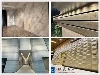

Irregular yellow wood grain slate fragmentation also undergoes thermal expansion and contraction, but if heated and then cooled, its contraction cannot return to its original volume and must retain a portion to become permanent expansion. The compressive strength of irregular yellow wood grain slate fragments may vary due to factors such as mineral composition, crystal thickness, uniformity of cementitious materials, loading area, loading action, and angle of cleavage. If other conditions are the same, a dense material with small crystalline particles that are usually bonded together has high strength. Dense volcanic rocks have no difference in compressive strength (extremely low water absorption) after drying and saturation with water. If they are porous and water sensitive cemented rocks, their dry and wet strength will differ significantly.

Irregular yellow wood grain slate fragments, hence the name meaning, refers to irregular slate, which is a leftover material produced during the production and processing of slate. Chaotic slate, due to its diverse specifications and the characteristic of being "scattered in shape but not scattered in spirit," often produces unexpected good effects during architectural decoration. It is also deeply loved by people who pursue freedom and fashion. Chaotic slate is widely used in public buildings, villas, courtyards, gardens, and large tourist resorts, giving people a feeling of elegance and returning to nature. Yongxiang Stone sells irregular stones for a long time:
Specifications:
- below 100cm, above 30cm, thickness: 2-3cm, 3-5cm,
- colors: mottled, rusted board, black, etc
Whether it is irregular yellow wood grain slate fragmentation or blue stone slate fragmentation, both can be classified under the category of stone ice cracks. There is not much difference between the two in terms of stone material, but from the perspective of texture, there is a significant difference between the two. Ice cracks can be understood as hitting a complete large ice block with a hammer, producing countless cracks. These irregular yellow wood grain slate fragments are small and uniform in width, and this pattern is called ice cracks. It is often formed by precise cutting of the entire board, so in form, it is more exquisite and upscale than fragmented assembly work. However, the processing difficulty is relatively high, so it is difficult to see large areas of ice cracks in the pavement, which is precisely why.