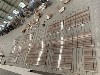

White marble is not transparent, but it can be translucent, especially when cut into thin slabs.
Here's a more detailed breakdown:
1. The Science Behind the Translucency
Marble is a metamorphic rock formed from limestone under intense heat and pressure. This process recrystallizes the minerals (primarily calcite or dolomite), creating a tight, interlocking crystalline structure.
- Crystalline Structure: Light doesn't pass through the thick, solid rock because it's scattered and absorbed by the countless crystal boundaries and microscopic impurities. However, when marble is cut into thin slices (typically 2-3 cm or less), light can penetrate the edges of these crystals.
- "Waxiness": This partial transmission of light is what gives high-quality white marble its famous "waxy" or glowing appearance. It's not see-through like glass, but it allows light to filter through, creating depth and a soft luminosity.
2. Practical Examples of its Translucency
You can observe this property in specific applications:
- Thin Slab Backlighting: This is the most common way to see it. If you place a strong light behind a thin (1-2 cm) slab of high-quality white marble like Statuario or Thassos, the entire slab will glow. This effect is often used in modern architecture for backlit bar fronts, wall panels, and decorative screens.
- Alabaster vs. Marble: For a clear comparison, think of alabaster. Alabaster (especially the gypsum type) is much more translucent than marble and has been used for centuries in lampshades because it diffuses light so beautifully. Marble has a similar, but much subtler, effect.
Image: A backlit white marble wall demonstrating its translucency.
3. Not All White Marble is Equally Translucent
The degree of translucency depends on the specific quarry and the stone's purity.
- High Translucency: Pure white marbles with minimal veining, such as Statuario, Thassos, and Carrara, tend to be the most translucent because they have fewer impurities to block the light.
- Low Translucency: Marbles with heavy, dark veining (iron oxides, graphite) or a more granular structure will be less translucent, as the veins and impurities act as barriers to light.
Summary
| Property | Marble | Glass (for comparison) |
|---|---|---|
| Transparent | No | Yes (you can see objects clearly through it) |
| Translucent | Yes (in thin slabs) | Can be (if frosted or textured) |
| Opaque | Yes (in standard thickness) | No (standard glass is transparent) |
In short: White marble is best described as having a translucency that gives it a glowing, luminous quality when light shines through a thin piece. In its standard, thick form, it is an opaque stone.