Stone is a natural treasure, and people use their wisdom to transform it into the ideal form, creating various spaces and styles. Today, let's talk about the different surface treatment techniques of stone.
As one of the two most commonly used main materials for indoor and outdoor applications, the surface treatment of stone is extremely important. It not only brings beauty to the space, but also meets the functional requirements of the characteristic space. If ignored, it may lead to design problems. For example:
1. The stone on the floor of the sauna room was not grooved or treated with acid washing, and smooth stone was directly used, resulting in the floor not being slip resistant.
2. The stone groove on the bathroom floor is not chamfered and smooth, which can cause toe cuts during showering.
3. The axe-chopped stone used for wall decoration contains dirt and is difficult to clean.

Why do stones need surface treatment?
I think there are at least three reasons why natural stone is surface treated before being presented in indoor spaces:
1. Satisfy the safety of the stone itself: As the stone is a natural material, if it is not surface treated, it is easy to cause alkali return, yellowing, or even weathering due to chemical reactions after leaving the factory.
2. Satisfy functionality: Different spaces and design techniques require stones with different properties to meet their functionality. In the application of stone materials for building exterior walls, techniques such as axe chopping ( pine-appled finish ) or bush-hammered surface treatment are used to reflect the thickness and strength of the stone.
3. Satisfy aesthetics: This goes without saying that any decorative material is endowing space with decorative qualities, and different stone surface treatment methods can also meet different design concepts. For example, in order to achieve a magnificent effect, high gloss stone is inevitable. Returning to the theme of stone surface treatment, I believe that in terms of material selection, besides natural and delicate texture, the rich surface treatment forms and super plasticity of stone are its essential differences from related substitute materials. So, what exactly is surface treatment of stone?
While ensuring the safety of the stone itself, different processing treatments are applied to its surface to present different material styles, in order to meet various design requirements.
This is called stone surface treatment. Any natural stone can be surface treated, but the suitable surface treatment form varies depending on the type and pattern of the stone. The appropriate surface treatment form should be selected according to the softness and characteristics of the stone.
Surface processing of stone
The surface treatment of stone is very rich, and according to our understanding, it can be roughly divided into three categories:
The first type is mechanical surface processing technology, such as polishing, matte, bush-hammered surface, axe chopping surface, etc.
The second type is chemical surface processing techniques, such as acid facial cleansers that we often refer to.
The third type is electrochemical methods, such as coating media on stone and electroplating copper.
1. Smooth surface (polished)
Polishing surface refers to a flat surface that is polished with resin abrasives or other materials to give it a mirror like luster. General stone can achieve a luminosity of 80 or 90 degrees, and some types of stones can even achieve a luminosity of over 100 degrees. However, some types of stones cannot be polished and can only achieve a matte finish at most.


Generally speaking, the higher the luminosity, the higher the price. Polishing surfaces are generally used in flat walls, indoor walls, floors, etc., especially in high-end buildings where the indoor walls and floors have high requirements for brightness. Its special feature is high luminosity and strong reflection of light, which can fully display the rich and vibrant colors and natural textures of the stone itself.
2. Flamed finish
Flamed surface refers to a rough surface finish made by processing the surface of stone with high-temperature flames generated using acetylene, oxygen, propane, oxygen, or liquefied petroleum gas as fuel. There are a few stones that cannot be processed by fire or have poor processing results.

Due to the burning effect, some impurities and low melting point components on the surface of the stone can be burned off, forming a rough finish on the surface, which may have a certain prickly feeling when touched by hand. The processing of burnt surfaces has certain requirements for the thickness of the stone to prevent it from cracking during the processing. Generally, a minimum thickness of 1.8-2CM is required, and some stones may have higher thickness requirements.
In addition, some materials may change color during the burning process, such as rust stone (G682). After flaming, the rust stone will show a certain light red color instead of the original yellow rust color. The characteristics of flamed surface are rough and natural surface, non reflective, fast processing, relatively cheap price, and often used for dry hanging on exterior walls, or outdoor anti-slip pavement.


This is the effect of making a flamed surface on granite surface. Using high-temperature gas of oxygen and propane to burn the surface of granite, when the crystals on the surface of the stone explode, this uneven effect is produced.
3. Bush-hammered Finish
Bush-hammered Finish stone are made by striking a hammer shaped like lychee skin onto the surface of stone, resulting in a rough surface resembling lychee skin on the surface of the stone. They are commonly seen on the surface of carvings or square stones. It is divided into two types: machine made bush-hammered finish and handmade bush-hammered finish. Generally speaking, handmade bush-hammered finish is finer than machine made bush-hammered finish, but it is more labor-intensive and time-consuming.


4. Line-chiseled
Line-chiseled finish is a rough surface formed by interlocking a straight hammer on the surface of stone. It is one of the most common methods for surface treatment of granite carvings.

5. Pine-apple finish (Rough Picked)
Pineapple finish is made by striking a stone surface with a chisel and hammer to create stone with an appearance resembling pineapple skin. Pineapple finish stone tiles are rougher than bush-hammered finish and line-chiseled finish. It can also be divided into two types: coarse pineapple and fine pineapple finish.

6. Natural cleft
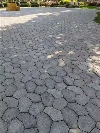
Natural surface refers to the processing method of using a hammer to naturally split a piece of stone from the middle, forming a surface that is extremely uneven and rough like a natural stone. The natural surface is extremely rough and widely used in products such as small squares and curbstones.


8. Grooved
Grooved surface refers to a groove with a certain depth and width on the surface of stone, which can be divided into fine grooved and coarse grooved finish. It is usually used to straight grooves, but can also be used to curved grooves with a water jet. The material cost is relatively high.