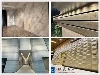
Physical & Mechanical Properties Test Report for Tea Rose Marble (Philippines)
Material Name: Tea Rose Marble (Commercial Name)
Origin: Philippines
Type: Metamorphic Rock (Marble)

1. Summary of Key Properties
| Property | Test Method | Average Value | Grade / Classification |
|---|---|---|---|
| Compressive Strength | ASTM C170 | 101 MPa (14,650 psi) | High |
| Flexural Strength (Modulus of Rupture) | ASTM C880 | 12.5 MPa (1,810 psi) | Good |
| Water Absorption | ASTM C97 | 0.18 % | Very Low |
| Density (Bulk Specific Gravity) | ASTM C97 | 2,700 kg/m³ (169.2 lb/ft³) | High |
| Modulus of Elasticity | ASTM C1352 | 48 GPa (6,960 ksi) | High Stiffness |
2. Detailed Explanation of Properties
1. Compressive Strength: 101 MPa
What it means: This measures the stone's ability to withstand loads that tend to reduce its size. It indicates the maximum pressure the marble can bear before crushing.
Interpretation: A value of 101 MPa is considered high for marble, making Tea Rose Marble suitable for floor and wall applications, including areas with moderate foot traffic. It is strong enough for most countertop applications, though care should be taken with heavy point loads.
2. Flexural Strength (Modulus of Rupture): 12.5 MPa
What it means: This measures the stone's resistance to bending or breaking under pressure. It's a critical factor for determining the required thickness for slabs, especially for horizontal applications like countertops.
Interpretation: 12.5 MPa is a good value. It means the stone has a reasonable resistance to cracking under its own weight when supported over a span. For kitchen countertops, adequate support (e.g., cabinetry, substructure) is essential to prevent cracking.
3. Water Absorption: 0.18%
What it means: This measures the amount of water the stone can absorb by weight when fully submerged.
Interpretation: A value of 0.18% is excellent and very low. This indicates that Tea Rose Marble is relatively non-porous and less susceptible to water damage, staining, and freeze-thaw cycles (if used outdoors in appropriate climates). However, sealing is still highly recommended to protect its surface and enhance stain resistance.
4. Density (Bulk Specific Gravity): 2,700 kg/m³
What it means: This is the weight of the stone per unit volume. Higher density generally correlates with higher strength and lower porosity.
Interpretation: This density is high, which is consistent with its low water absorption and high compressive strength. It gives the stone a solid, premium feel.
5. Modulus of Elasticity: 48 GPa
What it means: This measures the stone's stiffness or rigidity-its tendency to deform elastically under a load.
Interpretation: A high modulus (48 GPa) means Tea Rose Marble is quite stiff and will deflect very little under normal loads, which is a positive characteristic for large-format tiles and slabs.
3. Important Notes & Recommendations
Marble Softness: Despite its good mechanical properties, remember that marble is primarily composed of calcite (Calcium Carbonate), which is softer and more chemically sensitive than granite or quartzite. It is susceptible to scratching and etching from acids (e.g., lemon juice, vinegar).
Sealing: The low water absorption is excellent, but applying a high-quality penetrating sealer is mandatory for countertops and floors to prevent staining from oils and colored liquids.
Finishes: The physical values can vary slightly between different finishes (polished, honed, flamed). A honed finish will hide scratches better than a polished one.
Testing Variability: The values provided are averages. Natural stone can have variations, so it's always best to request the actual test report from your supplier for the specific batch of material.
Conclusion:
Philippines Tea Rose Marble exhibits very good physical properties-high strength, low porosity, and high density-making it a technically sound choice for a wide range of interior applications, including flooring, wall cladding, vanity tops, and countertops. Its primary considerations are related to its maintenance as a calcareous stone (susceptibility to scratching and etching) rather than its structural integrity.