

Excellent question. The answer is a nuanced yes, but it depends heavily on the specific type of marble and its thickness.
True translucency is a special and highly prized quality found in only a select few marbles.
What Creates Translucency in Marble?
Translucency in stone occurs due to two main factors:
- Extreme Purity and Density: The marble must be very pure, composed almost entirely of recrystallized calcite or dolomite crystals. Fewer impurities (like clay, sand, or iron oxides) allow light to pass through more easily.
- Crystalline Structure: When these pure calcite crystals are formed under immense heat and pressure, they interlock in a way that minimizes tiny air pockets and voids. Light can travel through this tight, glass-like crystalline matrix.
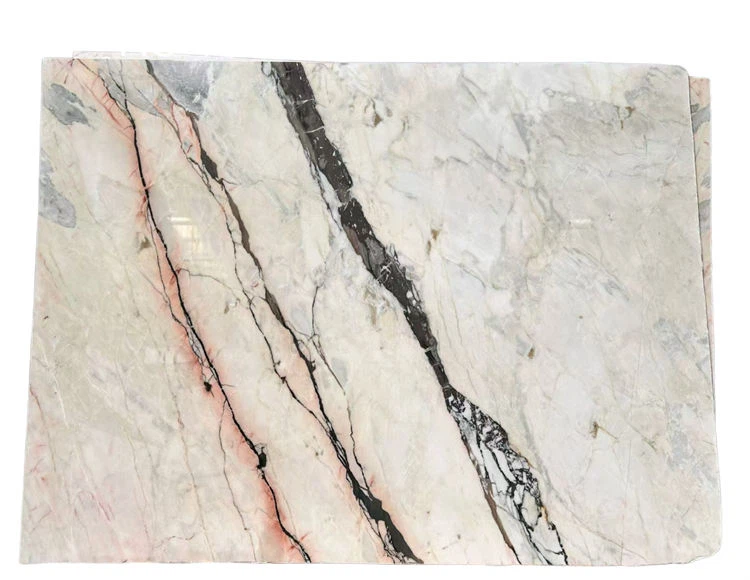

The Best Examples of Translucent Marble
Some of the world's most famous and expensive marbles are renowned for their translucency:
- Statuario (Carrara, Italy): The classic white marble from Carrara, especially the highest-quality Statuario variety, is famous for its bright white background and grey veining. When cut into thin slabs (1-2 cm / ⅜" - ¾"), it can exhibit a beautiful translucency, especially when backlit.
- Calacatta (Italy): Even more prized than Statuario, high-grade Calacatta marble often has a profound translucency that contributes to its deep, luminous glow.
- Arabescato (Italy): Another Italian marble known for its potential translucency when thinly cut.
- Thassos (Greece): This is a pure white dolomitic marble that is one of the brightest and whitest marbles in the world. In thin slabs, it can be highly translucent.
The Key Factor: Thickness
This is the most important point. A 3 cm (1 ¼") thick slab of Statuario will not be translucent. However, if that same slab is milled down to a 1 cm (⅜") or 2 cm (¾") thickness, light can begin to pass through the pure crystalline areas. This property is why these marbles are so coveted for thin panel applications with backlighting.
Translucent Marble vs. Onyx: A Critical Distinction
It is crucial to distinguish between translucent marble and another natural stone: onyx.
- Onyx: True onyx is a banded variety of chalcedony (a type of quartz). It is famously and often dramatically translucent. It is commonly used for breathtaking backlit bars, wall panels, and art pieces.
- Marble: Commercially, many stones sold as "onyx" are actually a banded calcite marble (geologically, they are travertine or calcite). Geologists will point out this is a misnomer, but in the stone industry, the term "onyx marble" is widely used for these strikingly translucent, banded calcite stones.
So, while both can be translucent, "onyx" (whether true quartz or calcite) is typically orders of magnitude more translucent than even the purest white Carrara marble.
Practical Applications of Translucent Marble
The translucency of marble is exploited in specific design applications:
- Backlit Feature Walls: Thin slabs (1-2 cm) are mounted with LED lighting behind them. The light shines through the stone, highlighting its veins and creating a glowing, luxurious effect.
- Thin Veneers: Used on furniture, fireplace surrounds, or interior windows where backlighting is desired.
- Sconces and Light Fixtures: Small pieces of translucent marble are used as shades for ambient lighting.
- Art Pieces: Sculptors sometimes use the translucency of marble for subtle lighting effects, a technique famously used by ancient sculptors.
Can Your Marble Be Translucent?
A simple test: Take a powerful flashlight (like the one on your phone) and press it against the stone in a dark room.
- If the stone is a standard marble (like most dark grey, green, or heavily veined types), no light will pass through.
- If it is a pure white or very light marble, you might see a faint glow penetrating a few millimeters, especially if the slab is thin.
- If a significant amount of light passes through, creating a glow, you likely have a high-quality translucent marble or a stone sold as onyx.
In summary: Yes, certain pure white marbles can be translucent when cut thinly, but it is not a universal property of all marble. For dramatic translucency, the stone in question is often "onyx marble" or true onyx.