
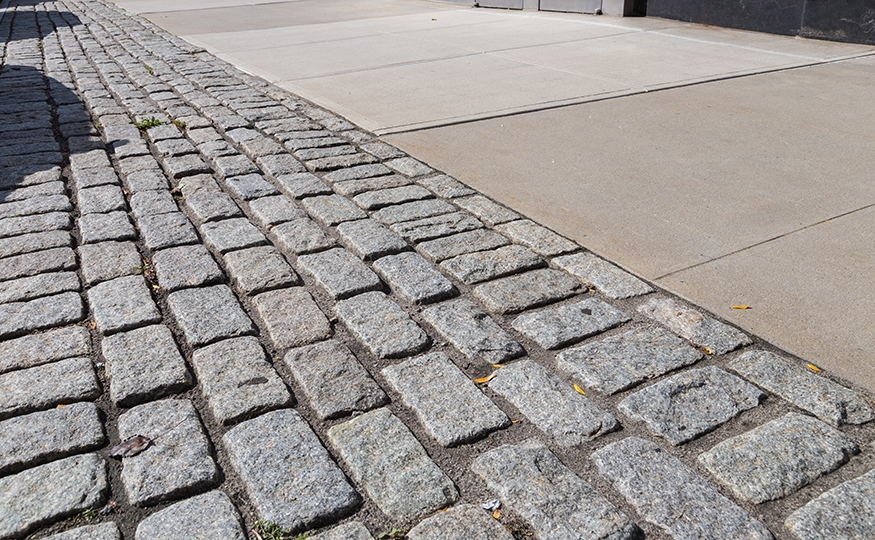
When planning a granite cube paving project, contractors and project managers often need to estimate how many granite cubes are required per square meter. The calculation mainly depends on the size of the granite cube stones and the joint width between stones.
Understanding this helps determine material quantities, project cost, and logistics planning.
Basic Calculation Method
The general formula is:
Number of cubes per m² = 1 ÷ (stone length × stone width)
All measurements should be converted to meters before calculating.
For example:
If the cube stone size is 100 × 100 mm
= 0.1 m × 0.1 m
Calculation:
1 ÷ (0.1 × 0.1) = 100 stones per m²
However, in real paving projects, joints between stones are required, so the actual number is usually slightly lower.
Typical joint width: 5–10 mm
Typical Granite Cube Stone Quantities
Below are common estimates used in paving projects:
| Cube Stone Size | Approx. Stones per m² |
|---|---|
| 90 × 90 × 90 mm | 110–120 pcs |
| 100 × 100 × 100 mm | 90–100 pcs |
| 100 × 100 × 50 mm | 90–100 pcs |
| 100 × 100 × 80 mm | 90–100 pcs |
| 200 × 100 × 100 mm | 45–50 pcs |
These values may vary depending on joint spacing and installation pattern.
Factors Affecting the Quantity
Several factors can influence the final number of granite cubes required per square meter:
1. Joint Width
Wider joints reduce the number of stones needed.
2. Stone Size Tolerance
Natural split granite cubes may have small dimensional variations.
3. Paving Pattern
Curved or decorative patterns may require additional material.
4. Cutting Loss and Installation Waste
Most contractors add 3–5% extra stones for safety.
Granite Cube Colors for Paving Projects
Granite cube stones are available in many natural colors for different paving designs, including:
Grey granite cubes
White granite cubes
Yellow granite cubes
Black granite cubes
Red granite cubes
These colors can be combined to create decorative plaza patterns, pedestrian streets, or landscape paving designs.
✅ Summary
For the most common 100 × 100 mm granite cube stones, the typical requirement is about 90–100 pieces per square meter depending on joint spacing and installation method.
When planning large projects such as plazas, municipal streets, or landscape paving, it is always recommended to include extra material allowance to ensure smooth installation.