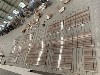

A few pictures for you to clarify your thoughts
The cutting process is very important in the processing of stone products. Cutting can not only improve the yield of stone, but also greatly enhance the production efficiency of stone products. Using some pictures in the article to help readers clarify how stone products are cut together? Understand the methods and precautions for cutting stone products?
1. Specification tiles processing cutting
The cutting of specification plates is the most basic and common method of cutting in stone product processing. Cutting large-sized tiles together with small-sized tiles can improve the yield of stone materials in this way. Figure 1 is a very simple cutting diagram for cutting specification plates. If the product in Figure 1 is not cut and only 1400 * 800 boards are cut, the yield rate will be very low, only 31%. When large and small sizes are cut together, the yield rate is significantly improved, reaching 82%. This is the greatest contribution and significance of sleeve cutting in stone product processing.

Figure 1
2. Processing and cutting of special-shaped plates
Figures 2-4 are common cutting diagrams for processing right angled triangles. When processing, simply cut along the thick solid line to obtain a right angled triangle. Figure 2 and Figure 3 can be divided into two right angled triangles, while Figure 4 can be divided into four isosceles right angled triangles along the diagonal lines AB and CD. Processing right angled triangles in this cutting method can not only improve the yield of stone, but also increase production efficiency.

Figure 2

Figure 3

Figure 4
To process the parallelogram product shown in Figure 5, the collinear cutting method shown in Figure 6 can be used. Figure 7 shows the isosceles trapezoidal cutting process.

Figure 5

Figure 6

Figure 7
Figure 8 shows the cutting process diagram for processing right angled trapezoids and right angled triangles.

Figure 8
Figure 9 shows the washbasin panel with the shaded area hollowed out in A1, which is a product that requires more processing. When encountering the need to process A2, A3, A4, A5, A6 products, the cutting method shown in Figure 9 can be used for processing. This is a commonly used cutting diagram in the processing of special-shaped plates, especially in the processing of patchwork, which is more widely used.

Figure 9
3. Large set cutting for mosaic processing
Figure 10 is a common cutting diagram for mosaic parts in mosaic processing, which is practical, valuable, and widely used.

Figure 10
4. Cutting in splicing processing
Splicing is a common product in stone processing. Due to its small size, if the cutting method is not used, the product is prone to breakage during processing, resulting in low production efficiency and significant material waste. If the cutting method is used for processing, it can not only improve the utilization rate of stone, but also increase production efficiency and improve the quality of the spliced products.
From Figure 11, it can be seen that if this type of splicing strip is processed as a single piece, the efficiency of manual grinding and polishing is very low, and it is also prone to breakage during grinding and polishing. By changing to processing according to Figure 12, it is evident that the efficiency of manual polishing is high and it is less likely to break. Processing using the method shown in Figure 11, the yellow strip is too thin and prone to breakage, making it difficult to process. By using the cutting method shown in Figure 12, the yellow stripes have been widened, the strength has been improved, and it is less likely to break during processing. The processing of the splicing in Figure 13 follows the same principle.

Figure 11

Figure 12

Figure 13
5. Smart cutting in arc plate processing
Figure 14 can be used for both the cutting of irregular circular arc plates and the cutting of circular arc plates, and has a wide range of applications.

Figure 14
6. Smart cutting in line processing
The cutting diagram in the line processing of Figures 15-17. Many companies in line processing do not know how to use this cutting method to process lines, resulting in material waste, increased processing time, and low processing efficiency. Because from the graphics, if these two lines are not cut using the cutting method of one section and two parts as shown in the picture, there will be a lot of material waste, and the depth of the line shape will be deep and time-consuming. If the cutting method shown in Figures 15 and 17 is adopted, the material can be saved by nearly half, and the molding time can be greatly reduced. Even the cut blank can be directly precision machined, greatly improving the efficiency of molding.

Figure 15

Figure 16

Figure 17
Figure 18 shows the cutting process of small lines with a width less than 50mm in the width direction, which has practical value.

Figure 18
Figure 19 shows the cutting process of short line strips in the length direction, which is often used.

Figure 19
The cutting method shown in Figure 20 is very interesting and innovative. Multiple lines are placed side by side in one piece, and then clamped and processed with a concave die. The efficiency of polishing with equipment is very high, which changes the process of manually polishing small lines.

Figure 20
7. Cutting in L-shaped plate and L-shaped line processing
Figures 21 and 22 show the cutting process of L-shaped plates and L-shaped lines. Processing L-shaped plates and lines in this way saves material and has high processing efficiency.

Figure 21

Figure 22
8. Cutting corner diagram
Figure 23 shows a line cut corner diagram, which uses collinear cutting to save stone and cut two corners in one go, resulting in high efficiency.

Figure 23
The cutting in stone product processing is far from what is described in the article. The methods and types of cutting are varied and diverse. This article is just a starting point. As long as readers pay more attention and collect more information in the production and processing of stone products, they will definitely find better ways and methods than the cutting described in the article.