
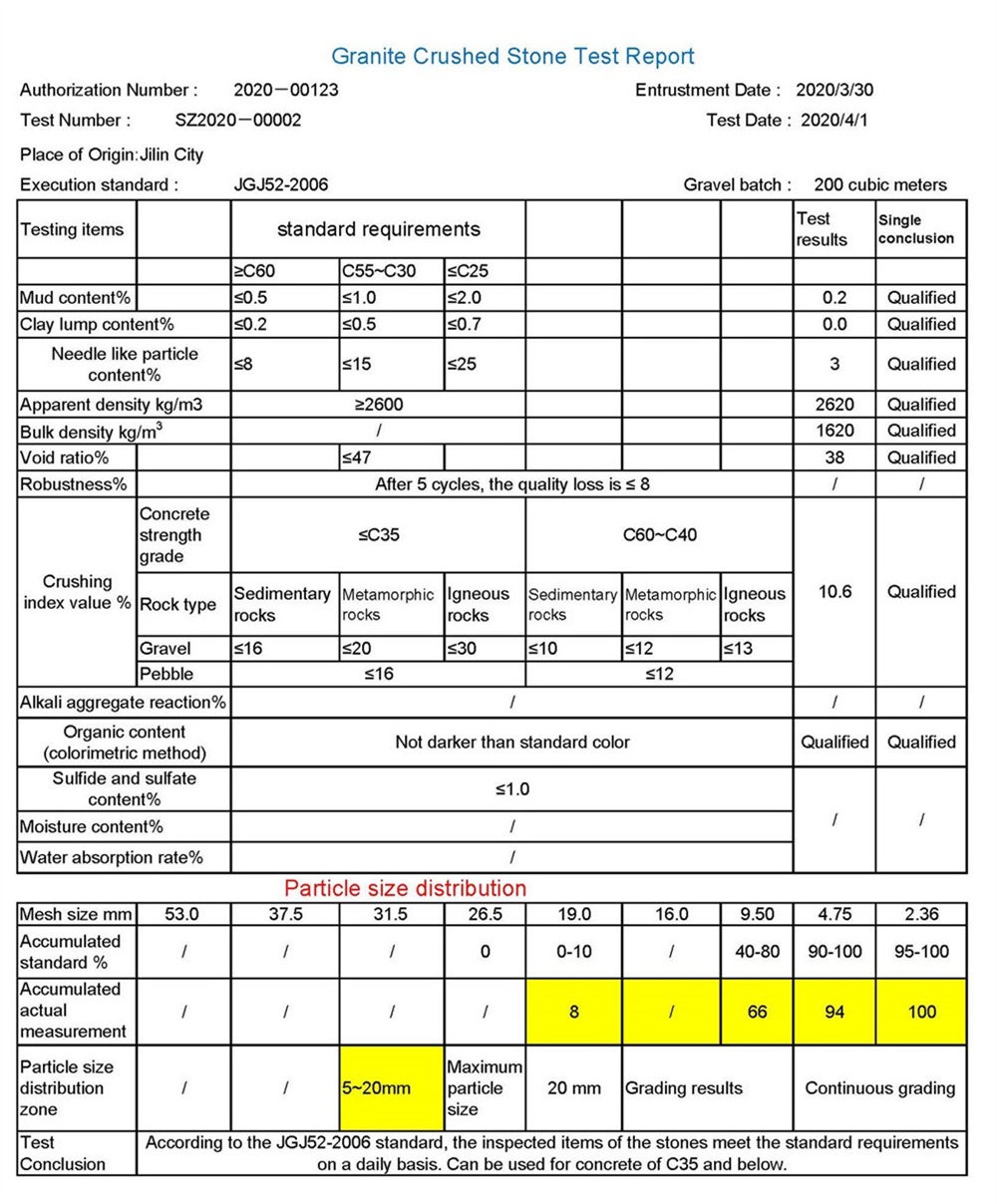
The density of crushed granite aggregate depends on factors such as particle size, grading, moisture content, and compaction. In engineering and construction practice, it is usually expressed in two ways: bulk density (loose/compacted) and particle (solid) density.
1. Typical Density Values
Bulk Density (Most Used in Projects)
Loose bulk density:
1,400 – 1,600 kg/m³ (1.4 – 1.6 ton/m³)
These values are commonly used for:
- Road base calculation
- Concrete mix design
- Material quantity estimation

Particle Density (True Density of Granite)
2,600 – 2,750 kg/m³ (2.6 – 2.75 t/m³)
This represents the density of the solid granite material itself, excluding voids.
2. Density by Common Sizes
| Aggregate Size | Bulk Density (kg/m³) |
|---|---|
| 5–10 mm | 1,450 – 1,650 |
| 5–20 mm | 1,500 – 1,700 |
| 5–30 mm | 1,550 – 1,750 |
3. Factors Affecting Density
- Particle size distribution (grading)
- Shape (angular vs rounded)
- Moisture content
- Degree of compaction
- Dust/fines content
Well-graded aggregates typically achieve higher compacted density due to reduced voids.
4. Practical Engineering Reference
For most construction calculations, engineers often use:
- 1.6–1.7 t/m³ as a standard average value for crushed granite aggregate.
Conclusion
- Bulk density (practical use): 1.4 – 1.8 t/m³
- Particle density (material property): 2.6 – 2.75 t/m³
Understanding the correct density value is essential for accurate material estimation, structural design, and cost control in construction projects.